US stocks climb again after Trump calls off his tariffs for Greenland

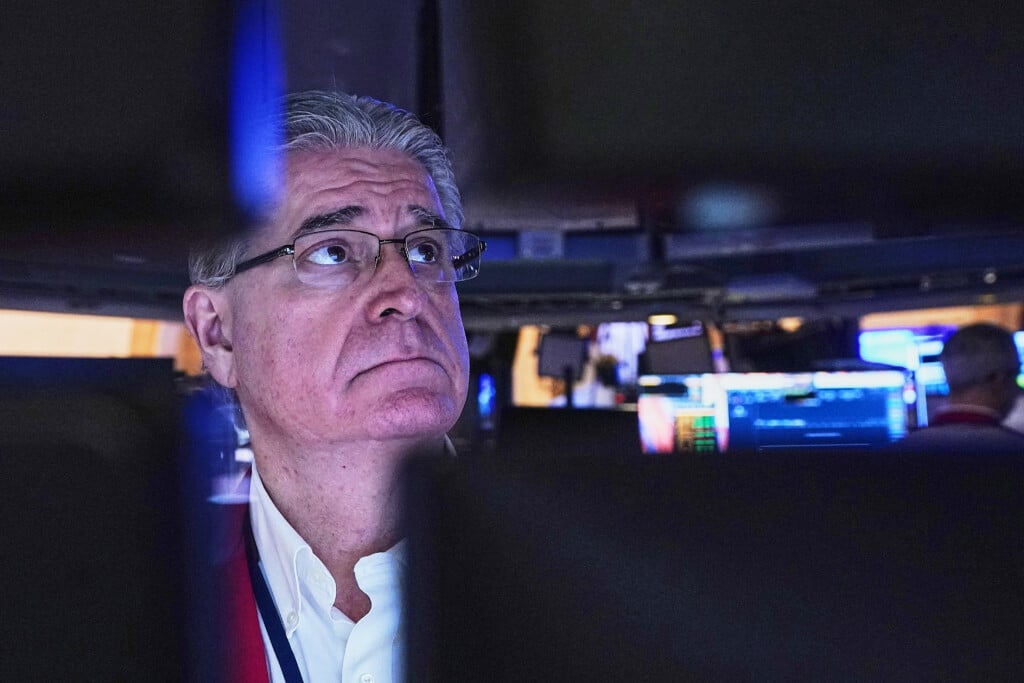
Trader Daniel Krieger is framed by his computer monitors as he works on the floor of the New York Stock Exchange, Wednesday, Jan. 21, 2026. (AP Photo/Richard Drew)
(AP) — The U.S. stock market is ticking higher Thursday and regaining more of its losses for the week following the latest walkback by President Donald Trump from tariffs he had earlier threatened.
The S&P 500 rose 0.4% and added to its big gain from Wednesday, when Trump said he had reached “the framework of a future deal with respect to Greenland” and called off 10% tariffs on European countries that he said opposed his having the Arctic island. The index has recovered most of its losses taken after Trump shook financial markets with his initial tariff threat.
The Dow Jones Industrial Average was up 260 points, or 0.5%, as of 10:15 a.m. Eastern time, and the Nasdaq composite was 0.6% higher.
It’s the latest example of Trump making a big, initial threat, only to pull back after seeing how much pain it caused in financial markets. The pattern has led to the “TACO” acronym, suggesting that “Trump Always Chickens Out” if markets react strongly enough. Tuesday’s drop for the U.S. stock market was the worst since October and large enough that Trump, who often takes credit when Wall Street is doing well, acknowledged “the dip.”
But the pattern has also led to deals for Trump that outsiders may have initially considered unlikely if not for his extreme initial threat.
Details are still sparse about the framework of a deal on Greenland that Trump said he reached with the head of NATO. And it is not a signed deal yet.
Financial markets nevertheless showed some signs of steadiness, though nerves were still apparent. Gold’s price seemed to pause its ascent into records as investors may have felt less urgency to own something seen as safe. The value of the U.S. dollar rose against some foreign currencies, though it fell against the euro, after sliding sharply earlier in the week when global investors bailed out of several U.S. markets.
Treasury yields held relatively steady in the bond market following some encouraging reports on the U.S. economy’s strength. One said that fewer U.S. workers applied for unemployment benefits last week than economists expected in a potential signal that the pace of layoffs remains low. A second suggested the U.S. economy grew at a faster rate during the summer than the government initially estimated.
A third said that inflation in November was close to economists’ expectations, while spending by U.S. consumers was a touch better than expected.
They helped the yield on the 10-year Treasury remain at 4.26%, where it was late Wednesday.
On Wall Street, Northern Trust climbed 5.8% after reporting a stronger profit for the end of 2025 than analysts expected. CEO Michael O’Grady also said that the financial services company is entering 2026 with “strong momentum across all our businesses.”
Procter & Gamble added 2.1% after delivering a better profit than analysts expected. Revenue for the company behind the Downy, Pantene and Tide brands, though, fell just shy of expectations amid what CEO Shailesh Jejurikar called a “challenging consumer and geopolitical environment.”
Another winner was Generac, which makes power generators. It rose 4.1% as forecasters warn a potentially catastrophic ice storm may hit a large swath of the United States.
They helped offset a 6.3% drop for spice seller McCormick & Co., whose profit fell short of expectations. CEO Brendan Foley said it continues to face rising costs because of “a shifting global trade environment.”
Shares of BitGo, a company that helps everyone from crypto businesses to traditional financial firms hold and manage digital assets, are set to begin trading later in the day on the New York Stock Exchange for the first time. The company priced its stock at $18 per share in its initial public offering, above its earlier estimated range of $15 to $17.
In stock markets abroad, indexes climbed across Europe and Asia amid relief on Trump’s walkback of tariffs.
Japan’s Nikkei 225 jumped 1.7%, and France’s CAC 40 climbed 1.1% for two of the world’s bigger gains.
Global markets also got support from a continuing easing of long-term yields in Japan’s bond market. They had spiked early in the week on worries that Japan’s popular prime minister could make moves that would add heavily to the government’s already big debt.
But the 40-year Japanese government bond yield has eased since hitting a record and dropped back below 4% on Thursday after hitting 4.22% on Tuesday.