As teen sextortion surges, US tech companies’ choices make abuse harder to stop
(AP) — Scammers are using U.S. technology to sexually blackmail teens, with sometimes fatal results. Yet recent changes by tech companies have not stopped the surge in sextortion, and some are making young people even more vulnerable online, an Associated Press and FRONTLINE investigation has found.

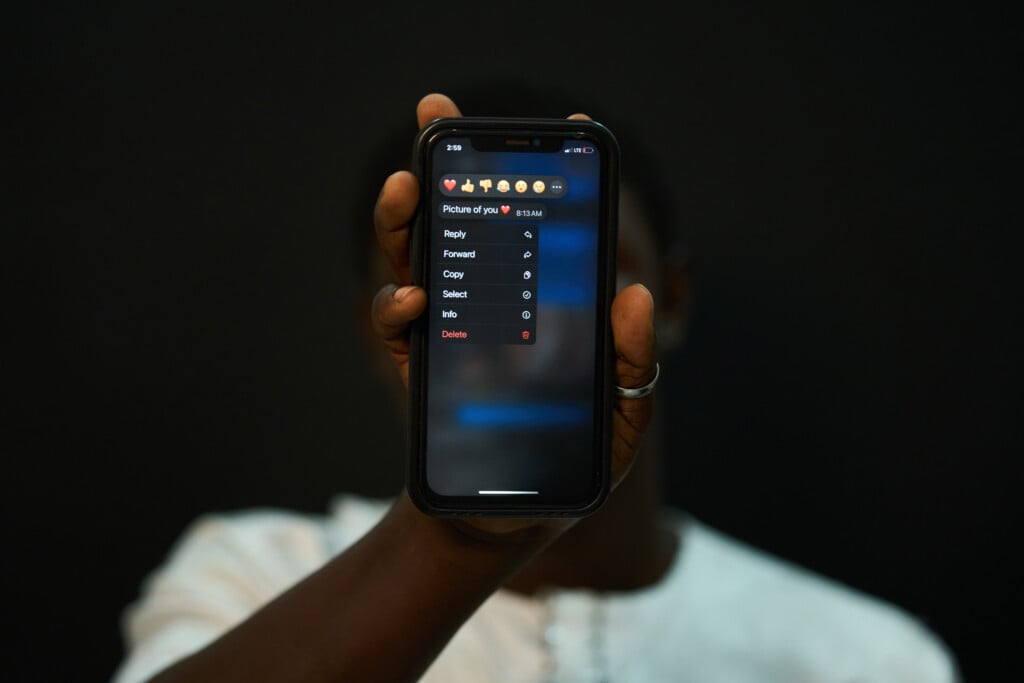
Junior, who is part of a thriving subculture in Nigeria of online scammers known locally as Yahoo Boys and who agreed to be photographed on condition that his full name not be published because of his illegal work, shows a message on his phone he sent a victim as he poses for a photo in Lagos, Nigeria, Aug. 1, 2025. (AP Photo/Grace Ekpu)
Financially motivated sextortion — threatening to expose people’s private images unless they send money — surged nearly 40% last year and now impacts more than 160 children every day, according to the National Center for Missing & Exploited Children, a nonprofit based in Virginia. The stakes are high: Since 2021, NCMEC has documented the deaths of at least three dozen teenage boys in the U.S. who took their own lives after being sextorted.
At least seven countries, including Australia, have adopted nationwide restrictions on social media use for kids, from minimum age bans to parental supervision requirements. Another 15 jurisdictions, including the United Kingdom, the European Union and Canada, have committed to or are considering similar rules.
But Washington has been concerned about hindering growth, free speech and falling behind global competitors. So the U.S. has largely left tech companies to police themselves — or face litigation after damage has already been done.
“The ecosystem as a whole is completely broken,” said Lauren Coffren, an executive director at NCMEC. “There is not enough being done. And it should have happened 35 suicides ago.”
Some recent changes by tech companies are making sextortion easier
End-to-end encryption allows only the sender and receiver of a message to see its contents, which bolsters privacy online. But that also makes it harder for platforms to spot and report potentially abusive material.
Meta knew that its controversial decision to roll out end-to-end encryption by default on Facebook Messenger by 2024 would impact child safety but decided the risks could be mitigated, according to a former Meta employee who worked in trust and safety.
___
EDITOR’S NOTE: This story includes discussion of suicide. If you or someone you know needs help, the national suicide and crisis lifeline in the U.S. is available by calling or texting 988.
___
Meta said its decision came as the industry as a whole was moving toward end-to-end encryption. The company acknowledged child safety issues were a concern and said it only put in the changes after developing new safety features for encrypted spaces. These include improved user reporting tools, monitoring for patterns of suspicious behavior and blocking suspect accounts from finding and interacting with teens, it said.
The expansion of end-to-end encryption contributed to a 19% drop in overall reporting of child sexual abuse material in 2024, according to NCMEC. Predators have started to move children to encrypted spaces more quickly, which is making it harder for law enforcement to build cases, NCMEC’s Coffren said.
Social media companies in the U.S. are legally required to report apparent child sexual abuse material, including sextortion, to NCMEC when they become aware of it. But there are no legal requirements for what they must do to detect it.
Meta, which owns Instagram, WhatsApp and Facebook, is the world’s largest social media company. In 2025, Meta platforms filed nearly 11 million reports to NCMEC, far more than any other social media company.
Along with Meta’s platforms, Australian regulators name Telegram and iMessage — which both offer end-to-end encrypted messaging — as platforms with the highest numbers of sexual extortion reports. Yet Apple filed just 296 reports to NCMEC last year.
Telegram, which is based in Dubai and not subject to U.S. reporting laws, only started reporting in 2026, according to NCMEC.
Both Apple and Telegram said they were committed to child safety, but neither responded directly to questions about their reporting to NCMEC. Telegram said it has been investing in content moderation, removes harmful content at NCMEC’s request and may disclose information about users in response to valid court orders.
“The right to private conversations cannot be surrendered simply because a minuscule number of people may misuse it,” Telegram said in an email.
After TikTok expanded direct messaging and allowed users to exchange images last year, reports of financial sextortion on the platform skyrocketed, according to data from Canada’s government-backed Cybertip.ca reporting hotline.
In 2023, TikTok was cited in just 2% of sextortion reports. By 2025 that had risen to 27%, and this year so far TikTok is the most cited platform, in 33% of reports, according to the nonprofit Canadian Centre for Child Protection (C3P), which runs the hotline and shared the data with the AP.
TikTok U.S. said it has safeguards in place and reminds users to share images only with people they trust, warning them that content can be downloaded or forwarded.
Steps tech giants have taken on their own to protect kids are falling short
Around 60% of online safety features meant to protect young people failed in tests this year by The Cybersafety Research Center, a nonpartisan, independent research group at New York University and Northeastern University.
“They are designed for public relations and theater. They are not designed to effectively reduce the harms we care about,” said Arturo Bejar, a former safety executive at Meta who contributed to the analysis. “Until we have independent measures of harm to regulate and control the outcomes of these companies, it’s going to be slow progress.”
Meta called the report, which included Instagram, “fundamentally flawed” and said it “demonstrates a basic misunderstanding of how our tools work.”
A number of platforms, including Meta, TikTok and Apple, have introduced teen accounts with higher safety standards, but teens generally don’t have to verify their age when they open an account. Meta and TikTok U.S. said they use other tools, like AI and community reporting, to identify underage users. Apple said it asks for age confirmation when required by law, which currently applies in Australia, Brazil, Singapore, South Korea, the U.K. and the state of Texas.
Meta and Apple have also created nudity protection filters that are active by default on accounts registered to teens, which detect potentially explicit images and encourage users to think twice before opening or sending them. But critics argue that they could just as easily block nude images of minors before they are sent.
Apple said its nudity detection feature is based on user devices, and the company does not receive indications that sensitive content was detected and cannot access the images.
Meta said it doesn’t block the images because the filters are designed to err on the side of caution and may mistakenly catch images that aren’t actually explicit. The company said that in June 2025, over 40% of blurred images received in direct messages stayed blurred. The company did not provide data on how many potentially explicit images the filters blocked teens from sending.
Another step Meta took to cut down on sextortion was to hide follower and following lists — which blackmailers use to pressure victims — from potential scammers on Instagram.
This summer, cybercrime analyst Paul Raffile set up a decoy account on Instagram — a teenage boy in the U.S. who was targeted by four sextortionists in just two weeks. All sent threatening screenshots of the account’s followers.
“The moment a teen accepts a scammer’s friend request on Instagram, their entire social network is compromised,” Raffile said. “The new safety feature was not effective in any of our tests.”
He said the four accounts were deleted after he reported them to Meta, but that accounts with similar usernames, profile pics and bios, soon popped up.
Meta said it restricts teens from being messaged by accounts they don’t follow, blocks suspicious accounts from seeing teens’ followers, and notifies them if they’re chatting with someone in another country.
The company said that in 2025 it prevented more than 265 million suspicious accounts on Facebook and more than 135 million on Instagram from finding and interacting with teens. It said it disabled 1.9 million of them on Facebook and 2.5 million of them on Instagram.
TikTok has also periodically taken down content that facilitates scams in response to public reporting. But that hasn’t stopped the proliferation.
The AP easily identified a dozen accounts on TikTok that promote tips, tools and scripts for sextortionists and other scammers.
In one case, a scammer bragged, using shorthand for “blackmail”: “If it’s your mother I BM yesterday may her soul rest in peace. I didn’t mean to kill them.”
Another scammer posted a video showing himself calling a woman while using AI to look like a U.S. soldier. The woman, whose name is visible on screen, is delighted.
“At least I know you are real,” she said.
Some of these profiles had hundreds of thousands of likes, with posts that got millions of views.
TikTok said it took down all the accounts AP identified for violating its guidelines, which prohibit facilitating or instructing people how to carry out scams. The company said it uses automation as well as people to find and remove harmful content.
But videos promoting tools for scamming continued to pop up on TikTok’s “For You” feed. The company said it again took down the additional suspicious accounts its algorithm had delivered — after AP flagged them.