Senate committee holds 1st of many meetings on artificial intelligence
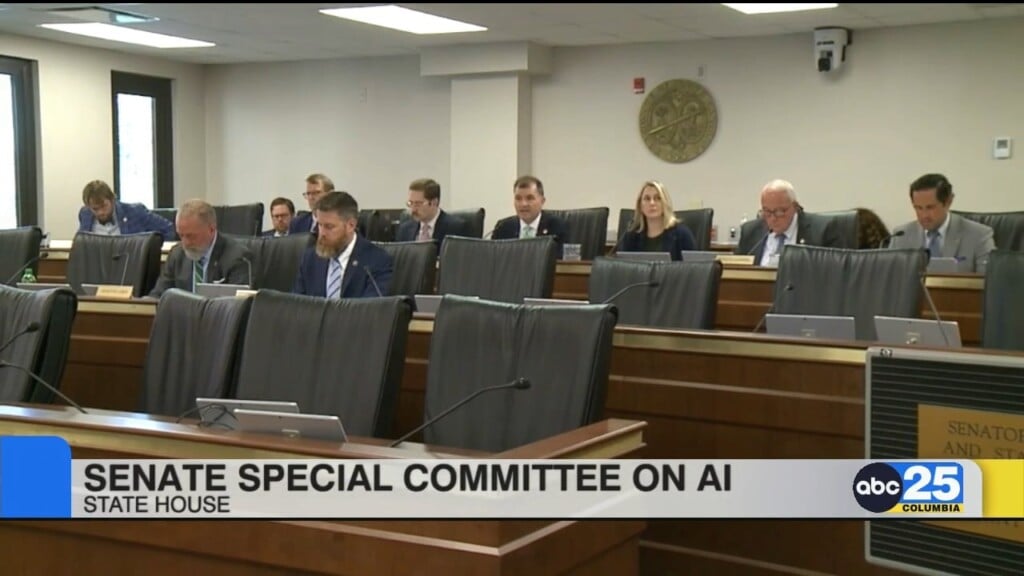
COLUMBIA, SC (WOLO) — Wednesday morning, a small group of lawmakers met inside the Gressette Building for a Special Senate Committee Meeting on artificial intelligence.
It marked the first of many hearings on the matter to come.
The nine members of the committee (including Senator Tom Young, Senator Mike Gambrell, Senator Richard J. Cash, Senator Josh Kimbrell, Senator Tameika Isaac Devine, Senator Jason Elliott, Senator Jeffrey Graham, Senator Matt Leber, and Senator Ed Sutton) will study both the uses and the risks going forward.
The committee will hear from a number of experts — as well as take input and concerns from the community. The ultimate goal is to adopt policies, guardrails, and an overall framework for the entire state in the near future.
One of the main topics of discussion — defining what artificial intelligence actually is, and what is considered to be artificial intelligence.
Speaking before the nine committee members and assistants, University of South Carolina Professor Bryant Walker Smith, gave one possible definition of artificial intelligence.
“First, AI means very broadly, the ability of the computer to navigate uncertainty by drawing inferences from experience available to it,” Walker Smith says, adding, “AI can refer to underlying technologies, like machine learning, implementations of those technologies, like chatbots, and uses of those technologies like medical advice. It can also be described by how it works, what it can do, and the risks and opportunities it presents.”
Currently 33 states have statutes around artificial intelligence. Seventeen-including South Carolina-do not.
Walker Smith says some states have adopted definitions that include “Does the artificial intelligence have human qualities?” “Does it replace or assist humans?” And “Can it infer or adapt to new information?”
When it comes to generative AI, the most talked about form of AI, and which is part of what’s known as machine learning, he gave a simple example: “The analogy might be training a dog. Throw a stick, give it a treat, throw a stick, and eventually the dog learns what you want it to do.”
After broadly defining AI, a number of questions arose from lawmakers.
“Are we looking at an era that we have to create a new canon of law to address when the machine does things unforeseen that are harmful to our citizens?” asked Senator Matt Leber.
“Could you ever get to the point, and I’m actually asking this, this is not theoretical, is the machine capable of becoming sentient where you treat it as its own agency?” asked Senator Josh Kimbrell.
Director of USC’s AI Institute, Homayoun Valafar, saying technically…yes.
“There is religion and spirituality that we are removing from this conversation, from the neuroscience perspective….Yes. Your brain — it is nothing more than 80 billion neurons that are connected together, and machines are arriving at that hardware specificity,” says Valafar.
The experts also gave recommendations to the committee. “Current law is very much a second best solution already. AI is going to yes introduce some new problems, introduce new solutions, exacerbate some problems, mitigate some problems,” says Walker Smith. “If you get stuck in the weeds, you’re not going to accomplish much. If it was up to me, I would focus on a very specific branch of AI that is of critical importance, develop policies, in the process learn the whole thing better, before you expand your scope and go to the big fish,” says Valafar.
Members were invited to visit USC’s AI Center.
The committee will meet again in the coming weeks. Its goal is to create a full report of recommendations by September, 2028.
Community members can contact the committee by email at aicommittee@scsenate.gov. There will also be a public facing website to discuss the ongoing AI meetings located within scstatehouse.gov.
“There are a number of ways to define artificial intelligence. Different states have taken different approaches. This is something we really need to put some thought in, as we evolve through this in the coming months. I think that the professors that were here today gave us some really good insight ona number of areas, and I look forward to continuing this discussion and hearing from future witnesses,” says Committee Chair Senator Tom Young.
Young added that rules created by lawmakers in the future regarding AI are not expected to be placed on the private sector.